The Landauer family leaves Europe
The Glass RoomThe Landauer family leaves Europe in a journey whose paperwork promises a route to safety but cannot guarantee that a family will remain together. From Geneva by train, through a confrontation with German officials at Bayonne, and onward toward a ship for Cuba and eventual flight to America, the escape turns borders into places where documentary status is tested by discretion and force. Its decisive rupture comes when Katalin and Marika are detained and the train departs without them; behind the travelers, their home and the life it contained are left to weather and war.
Planning an escape
The journey is not a simple passage from one country to another. To secure Cuban visas, Viktor has had to meet a formidable list of requirements: a fee of two hundred and fifty dollars for each applicant, a letter of credit for two thousand dollars, a five-hundred-dollar caution against a visitor’s failure to leave, a further security payment of one hundred and fifty dollars against onward travel, and return tickets. The return passage is itself an imposed condition, intended to put a traveler back aboard if there is nowhere else to go. The ship’s ticket, a booklet decorated with a liner steaming toward a vivid sunset, costs seven hundred dollars alone. The image of an open horizon is thus bound to a costly system designed to make departure conditional.
Before boarding, Liesel tries to write to Hana. Her brief postcard says that the family is finally going, that she has received Hana’s nineteenth letter, and that she longs to be with her but cannot. She urges Hana to go ahead with what she wants and hopes to write again from Bilbao. There is scarcely room on the card, and the family is already being hurried toward the train. The message carries a painful double meaning: Liesel’s departure is an act of survival, but it also makes continued closeness to Hana uncertain.
The departure from Geneva
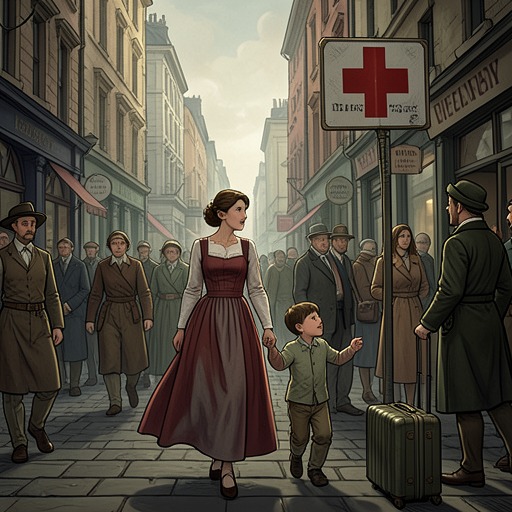
At Geneva station, the family enters a crowded, noisy space where escape has become a public ordeal. Steam, carbon, and sulphur fill the air; passengers call from train windows while others push suitcases through them. Officials inspect papers and tickets amid arguments and panic. Viktor leads the group through the crowd with a porter and a trolley piled with luggage. For Liesel, the scene recalls the station in Město where she once met Rainer, when he had come to survey the site for the new house. That earlier beginning is now overturned: the house is no longer theirs, Rainer is in America, war is consuming Europe, and Liesel is following Viktor toward exile.
The family settles into a crowded sleeping compartment. Martin wants the upper bunk, as if the journey were camping; the children are assigned the other upper bunks, while Viktor and Liesel take the lower ones. As the engine bellows and the train begins to move, Liesel says that at last they are really going. The words mark a threshold, but not a feeling of uncomplicated release. Officials check their documents as the train passes through Switzerland, and the route ahead—Lyon, Montpellier, Toulouse, Bayonne, Biarritz, Spain, and Bilbao—remains dependent on each further inspection. Liesel weeps, clutching the postcard to Hana and wondering how it can reach her. The family is leaving for good, and the message may never arrive.
Bayonne: papers and separation
At Bayonne, the refugee family’s movement is halted by document checks. Soldiers search the train, and rumors circulate that people without papers have been removed. Passengers queue under the pressure of a test whose outcome is uncertain: some are allowed back aboard, while others are taken aside. Viktor presents the family’s documents in neat piles and identifies those traveling with him: himself, his wife, their two children, the children’s nanny, and the nanny’s daughter. Passports, French transit visas, Spanish visas, and tickets are examined, but possession of a substantial file does not settle who will be permitted to travel.
The questioning turns on Katalin’s status. When an official addresses Viktor, Katalin says that her documents are all she has; Viktor explains that she is in their employ. The soldier rebukes him for speaking without being asked. After officials confer over Katalin’s passport and visas, a uniformed man takes her by the elbow and leads her toward a hut. Marika cries for her mother. Liesel pulls the girl close and insists that she is with the family and will be looked after. The moment makes the difference between formal eligibility and actual protection brutally immediate: the papers are present, yet mother and daughter are removed from the train’s company.
Marika is then taken toward Katalin, and Viktor protests that Katalin’s refugee passport—a Nansen passport—contains everything required. The official orders him back into the train and warns that he could be detained too. Viktor argues that the documents were accepted when they entered France and should suffice for Spain. Behind him, the crowd presses forward, its attention fixed on surviving the inspection rather than intervening. The official offers only the possibility that the delay may be temporary. A young soldier pushes Viktor’s family back toward the carriage and removes Katalin’s and Marika’s suitcases. No assurance resolves what will happen to them.
The train leaves without them
The confrontation has already widened into a family crisis. Viktor sits with blood on his hands as Liesel screams at him, accusing him of valuing Katalin above his wife and children. Afterwards, the compartment falls quiet: Ottilie cries, Martin turns to a book, and Liesel and Viktor sit side by side at a distance that reflects the rupture between them. Outside, soldiers pace the platform while people stranded below look up at the train as though at another world. The scene joins political violence to marital fracture without making either one erase the other.
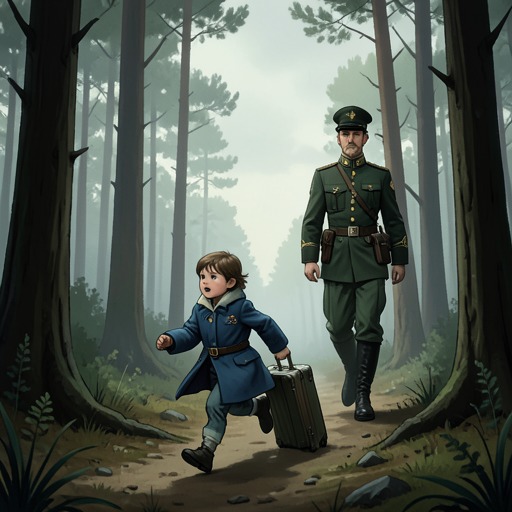
Then the engine releases steam and the carriage jerks forward. The children ask where Marika has gone, but there is no answer. The train passes through a short tunnel and across a bridge; Katalin and Marika do not reappear. Viktor, his face streaked with dried blood, asks Liesel what else he could have done. She looks away, feeling the confinement of the compartment, and turns to the children when she senses the air changing. The breeze comes from the west and carries the scent of the ocean. That concrete sign of the approaching coast accompanies an escape that has not brought everyone along.
Later, in Spain, the family speaks quietly while the children sleep. Viktor is hunched in the darkness, and Liesel recognizes from his shoulders and breathing that he is weeping, though she has never known him to do so before. Her response is anger and urgency: she tells him to pull himself together and think about what they might do when they reach Bilbao. The departure demands that the survivors keep moving even while the loss at the station remains unresolved.
Exile and the abandoned home
The route continues toward Bilbao, where the family is to board a ship. At the villa, a camera records Viktor in a lightweight suit and panama hat, Liesel in a floral dress and straw hat, and the children beneath broad-brimmed hats. Martin’s attention wanders to a lizard; Ottilie tries not to giggle. Viktor calls the photograph the last souvenir of their tropical paradise. Outside, a car waits to carry them to the port and the flying boat that will take them toward a promised future. The family’s departure is thus marked by both a staged keepsake and the practical onward movement from villa to port.
The narrative then turns from the departing family to the house without its people. The building is reduced to an enclosed box exposed to wind, rain, snow, and the slow damage of water: paint and concrete flake, tiles loosen, and steel rusts. Passersby on Blackfield Road speculate that the owners may be in Switzerland, Britain, or the United States, but their guesses do not become knowledge, and their attention is absorbed by the ordinary struggle to find food, keep a coat through another winter, and wait for the war to end. The family’s flight therefore leaves two forms of uncertainty behind: the immediate fate of Katalin and Marika, and the larger question of whether those driven abroad can recover either their home or their former life.